Sunday, June 20, 2010

NXNE - The Headlining Day

No matter who was talking, or where the conversation was taking place, it seemed like only a matter of time until the chatter turned to the largest name on the bill for the festival: Saturday night had arrived and Iggy Pop and the Stooges were to play the mainstage at Yonge Dundas Square. There was palatable excitement on patios and on the streets as everyone geared up to catch the punk forefathers' set.

Considering we had yet to hang out at the mainstage, and the fact that the afternoon's line-up included bands like Wavves and the Raveonettes opening for the Stooges, a hot afternoon in the beer gardens seemed like the thing to do. Surfer Blood was the first band we caught, but their set was all but terrible. Marred with technical difficulties, and compounded by a lack of charisma in front of a decent-sized crowd, the Florida indie surfer rockers' set was a complete letdown. Even their critically acclaimed single, "Swim," failed to really win anyone over.

Wavves set up next, dressed in sloppily tie-died shirts and colourful pants. Perhaps better known as Jay Reatard's backing band, with Billy Hayes on drums and Stephen Pope on bass, Wavves have enjoyed some critical success since the release of their self-titled debut in 2008. Their noisy, lo-fi punk was filled with poppy hooks that were enjoyable in the warm Yonge Dundas Square and their zany antics entertained the increasingly packed public space.

Wavves' Nathan Williams (guitar) and Billy Hayes (drums)

By the time the Raveonettes started their hour-long set, there was a vibrant current running through the crowd. Not only were the Raveonettes the last opening band for the festival headliners, but the Danish noisy alt-rockers, equally inspired by the Jesus and Mary Chain and the Velvet Underground, were also heavily anticipated. Through a cloud of fog, guitarist and vocalist Sune Rose Wagner and bassist and vocalist Sharin Foo, who was wearing her trademark black polka-dot dress, stepped onto the stage and greeted an audience that was in the thousands. The Raveonettes whipped through a set that undoubtedly converted many to their own brand of early '90s-inspired, guitar driven, noise rock.
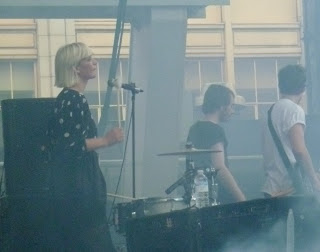
A different kind of Foo fighter

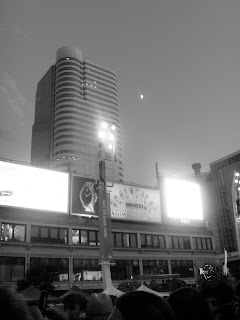
Regardless of the strength of the Raveonettes' set, everyone was undoubtedly waiting for the Stooges' set. Flight cases were opened to reveal their guitar amps, a large drum kit was wheeled forward, and thus, the NXNE mainstage was primed for the punks' triumphant return to live performance. As soon as frontman Iggy Pop's wiry, lanky, topless form cooly sauntered onto stage, the entire square and beyond — the surrounding roads had been closed to allow for greater capacity — exploded in ecstasy. The crowd at the front of the stage messily thronged and surged in time to the opening song, "Raw Power." Pop himself seemed to revel in the glorious mess he created below, wrapping his torso around the microphone stand and contorting his frame in the most serpentine positions.

Raw power

The whole hour-and-a-half set was exactly what you could have expected: the music was loose and comfortable, the Stooges — or, as Pop put it, early in the set, "the remains of the Stooges" — were obviously having a fantastic time, and it was wildly exciting to hear classic tracks like "Gimme Danger," "Your Pretty Face Is Going To Hell," and, not least, "Search and Destroy" played live. And seeing Iggy Pop and original guitarist James Williamson was definitely a wonderful treat to cap an already stunning festival. But, as the set progressed and I roamed the square, moving from the very front of the stage to the sidelines and then to the back, I couldn't help but feel increasingly soured on the whole production. Because that is exactly what it was: an overdone production that seemed antithetical to the Stooges themselves. The Stooges used to play to indifferent and hostile crowds in seedy dives, and while it would be unfair to romanticize those sets as objectively better than the one on Saturday night in front of a veritable urban arena, it still felt hugely disconnected to watch Pop wind his way through "Shake Appeal" or "I Wanna Be Your Dog" underneath massive neon billboards selling thirteen-dollar H&M dresses.

Perhaps the most punk man at the festival?

More than that, the Stooges' music is meant to be intimate. It is meant to be in-your-face, savage and uncomfortable. Pop used to mangle his body in service of a nihilistic anarchy that eventually became punk in order to get a rise from his hostile crowds, in order to express, in whatever words he could, the incredible anger and angst he felt. The Stooges' music is dark and scary, revealing parts of the human psyche that are perhaps best left untouched. To hear the powerful opening verse to "Search and Destroy" — "I'm a street-walking cheetah with a heart full of napalm/I'm a runaway son of the nuclear a-bomb/I'm a world's forgotten boy/The one who searches and destroys" — is to access a deep dissatisfaction with the world around you at large. Iggy Pop fully considered his Michigan hometown a war zone and was desperate for love in the middle of a firefight, for someone to save his soul: a tormented soul, a lost soul, a soul that grew up in a world that was illegible.

All of that was lost on Saturday night at Yonge Dundas Square, underneath the happily beaming neon advertisements and family-friendly mainstage. It was tough to, near the end of the set, catch a glimpse of Williamson soloing or Pop dancing through Playstation and Virgin Mobile banners, jutting up proudly from the tents set up at the back of the square. It was almost surreal to wander over to a street on the side and find that a double-decker tour bus had parked itself plumply in front of the Hard Rock Cafe so that tourists — either to the city, to the festival, or to the music itself — could calmly snap photos from the top deck in order to take back home and placidly share the next day. Worst of all, the sheer size of the event made it all seem like a transaction: not an economic transaction, since the mainstage itself was a free event, open to anyone in Toronto, but a cultural transaction. What was traded during the Stooges' set was presence for status-producing cultural capital. Just being there was enough — no one had to, or could, ultimately, feel anything. People could calmly shuffle and bop to "1970" as if it were another Top 40 song to be consumed — and reconsumed in stories the next hour or day, stories that are intrinsically and systemically designed to return high cultural profit margins. The sheer scale of the production was, ultimately, the production's downfall: it collapsed underneath itself because punk, proto-punk, honesty — whatever it is that was originally felt in 1969 when the optimism of the flower generation woke up to a grisly hangover — was never meant to support such a large, universal, event. The music was amazing, to be sure, but it was meaningless.

Although, as Johnny Rotten once said of the Sex Pistols' reunion in 1996, perhaps this sort of orchestration is more punk than any gutter show could ever be. It was undoubtedly effective: I hated everyone and everything as I stalked away.


Saturday, June 19, 2010

NXNE - Friday Night in the Dark

As if to set the mood for another sticky night of rock and roll, a good chunk of downtown Toronto was plunged into an eerie blackout just as the sun ceded to darkness. Bars and clubs emptied out into the street and the night air was exuberant with cries of laughter and car horns.


Way out west on Queen St, at the Gladstone Hotel, an enormous line of indie kids wound its way down the street. Inside, dd/mm/yyyy were setting up an array of pedals, broken cymbals, keys and guitars in front of a replete hotel lobby. After a lengthy set-up, the experimental post-punks started a set that was, not surprisingly, heavily tailored for the predominantly hip audience. The quintet played tightly and confidently, though they seemed somewhat distant and cooler than thou for the adoring audience.


Not pictured: a plethora of pedals.


As soon as their set was up, C'mon was ready at the front of the stage, road-torn 4x12s — actually haggard from touring rather than the carefully broken amps used by dd/mm/yyyy — rearing to blow the dwindling crowd away. As was to be expected, the Gladstone emptied out somewhat after the indie darlings' set, but the Toronto/New Orleans band was undaunted. To be sure, as soon as their sparse stage was set — just two guitar amps, a bass amp and the drums — C'mon played one of the best opening songs I've seen in a while. In just a few short minutes, frontman Ian Blurton called out anyone who remained after dd/mm/yyyy's set who was expecting more of the same, soloed wildly through the crowd, gave his guitar to an audience member, inviting him up on stage, and smashed his beer bottle on the far wall. In short, he woke the crowd up with nothing short of a kick to the teeth.


Rock and roll, the way it's meant to be played.


For the entirety of their 40-minute set — a set that was pushing up against the next time slot, to the consternation of the stage manager — C'mon refused to let up. A dedicated group of fans near the front rocked out, which the band seemed to appreciate, since most others in attendance were content to bob their heads in time with the raucous, loud and obnoxious rock and roll. Bassist Katie Campbell (ex-Nashville Pussy) tore her Rickenbacker bass apart as if she was trying to exorcise demons, thrashing on stage so much that her strap-lock button broke, forcing her to her knees as she didn't miss a beat.


A quick change of venue — and, decidedly, of pace — saw us arrive at Czehoski for Brooklyn three-piece Brit & the Cavalry. The jazzy rock band, fronted by the very talented Brit Boras, played a mellow show that delighted those few sitting at tables at the back of the narrow venue. Though it was perhaps not the best remedy for a Friday past midnight, it was still a talented set.


At one point, she was even double tapping the melodies!


Unfortunately, the rest of the line-up for Friday night was less appetizing. As we hung around outside, wondering where to head next, we ran into Sarah Ford, who passed on a rumour that Iggy Pop and the Stooges were playing a secret, intimate, show far west on Queen. Deciding it was unlikely, though too good a rumour to ignore, off we went to the Cadillac Lounge, only to be disappointed. Iggy Pop was not there and in his place was a mediocre band called Flashlight Radio. A quick cab ride solved that problem, though, and soon we were back at the Bovine to see Thee Oh Sees play their secret show at 2 am.

Friday, June 18, 2010

NXNE - Day Two - Dragging ourselves home while people go to work

If there is one thing that Calgary lacks, it's a bar with the kind of attitude that literally hangs off the wall at the Bovine Sex Club. This long, narrow, dark hideout on Queen St W has seen its fair share of legendary shows throughout the years, and it is easy to see why: it is the kind of bar where rock and roll triumphantly claws back to the gutter, stealing back the thrill of speed and fearless bravado in the face of death from those who shed their black jeans for ill-fitted cut-offs. The black piping that separates the stage from the venue looks violently ominous, as if more than one zealous fan has been impaled in ecstasy.


Of course, the downside to the Bovine is that early shows tend to be less-than-spectacularly attended. By the time garage rock darlings miesha & the spanks took the stage at 9pm to open the night's proceedings, only a few outsiders had wandered in from the sunny sidewalk. Those in attendance — including a bike rebellious bike courier intent on taking down the G20 and band members from the rest of the bill — certainly enjoyed the duo's strong set. This was only the fourth set with new drummer Stu Bota, and though they are still looking to dial in that tight chemistry that forms over time, it is clear that Bota adds a new dimension to the spanks' tunes, easily shuffling underneath frontwoman Miesha Louie's dirty guitar and powerful voice.


Miesha Louie, comfortable even at a sex club for farm animals.


As luck would have it, the Torontonian version of miesha & the spanks, the similarly styled little foot long foot, was playing at a venue not too far from Bovine. A short jaunt up Spadina later, and the newly-augmented three-piece was barreling through their set. Frontwoman Joan Smith seemed at ease with the gathering crowd, wielding her large, hollow-body Yamaha and confidently blasting through the part rock and roll, part roots, part country — with a little bit of punk mischief — set. Though she and drummer Isaac Klein have been a two-piece since the beginning, this was the first show with their new organist, Caitlin Dacey from Bella Clava, who had played a showcase at the Hideout right before rushing over to El Mocambo. Dacey's distorted organ tone was a fantastic complement to an already strong duo, giving the songs more body and weight, especially on the bass end. Along with a new member, Smith unveiled some new songs, including the tentatively-titled "Neko Case Hate Fucks Kurt Cobain."


Thankfully, Joan Smith did not hate fuck Cobain.


Back at the Bovine, Northern Australians Terracotta Pigeons

were in the midst of their genre-bending set. At times metal shred,

at times funky, and, incredibly, at times almost rapped, the Pi

geons certainly demonstrated that they have years of experience behind them. While their songs sometimes faltered, borrowing from genres too far removed from hard rock to be effective, it was an overall good set. Drummer and vocalist Steven Smith takes direct cues from Mike Patton in both his drumming style and vocal delivery and it works well for him — he has the strength and stamina to keep up with the demanding performance and still be a vocal presence from behind the kit.


The highlight of the night, though, by far, was the first 222s show since 1981. The 222s are amongst Montreal's first punks — they released their debut in 1978 — and still today, three decades later, have the angst energy and charisma to slay the packed audience at the Bovine. This is really the beauty of large festivals like this: it gives bands like the 222s the opportunity and venue to reform, more often than not as a one-shot deal, and showcase themselves to an entirely new audience. The 222s are classic late-'70s punk and seem to be an amalgamation of their punk peers: vocalist Chris Barry is a cross between Johnny Rotten and Joey Ramone, alternatively sneering and lurching over the barrier, singing with an energy that surpasses punks half his age. Guitarist Pierre Major was slightly subdued, dressed in a CBGB shirt and checkered bondage pants, but played with flawless precision, soloing effortlessly and confidently. The full house loved the performance and it is fortunate that it is not their only set of the festival. The 222s were simply amazing.


Chris Barry, like the '80s never happened.


As soon as the 222s strummed their last chord, it was time to run to the Dakota Tavern, where the Japandroids were playing a secret show. Like any good secret, though, everyone seemed to know exactly what was going on, and the basement tavern was packed to capacity, sweaty, and not even remotely sober. On the small stage, the Vancouver garage rock duo that has rocketed to fame on the strength of their debut, Post-Nothing, played a short, 40-minute set, but it was, like all Japandroids shows, nothing short of controlled mayhem. Within the first notes of "The Boys Are Leaving Town," the dance floor was foaming with spilt beer and sweaty bodies. Guitarist and vocalist Brian King was in fine form, wrenching fuzzed out chords while drummer David Prowse loped along on easily and fluidly. While they haven't released any new full-lengths, they have been busy with a stream of EPs and singles, and, early on a Friday morning at the Dakota, they revelled in being able to share their latest with an adoring crowd. By the time they played their last song, "Heart Sweats," no one wanted to see them off the stage.


Brian King, this time, without his floor fan tousling his hair.

Back to the hotel...

Up today: Brant Bjork, Bad Tits, Flatliners, C'Mon, Mini Mansions, Sex With Strangers, the 222s (again!) and more!

Thursday, June 17, 2010

NXNE - Wednesday, June 16


Ah, that new festival smell. As downtown Toronto alternated baking and soaking in the fickle June weather, NXNE got underway with not a little aplomb. After a fun afternoon hanging out at the NXNE headquarters at the fancy Hyatt, where more than scruffy drunk rocker seemed out of place, to the dismay of the hotel's regular patrons, the first festival chords were struck.

Without a doubt, the main draw for the evening was Eagles of Death Metal at the Phoneix Concert Theatre. Only the first 200 fans were let in, which guaranteed jostling and name-dropping at the door to see charismatic frontman Jesse Hughes tantalize and tease all the "beautiful baby girls" in the audience.

Off the beaten path, however, hidden away in the Kensington Market, the Supermarket was host to a slightly unofficial showcase. Even though the bill, which included The Treasures from Toronto and the Manvils from Vancouver, was not officially announced in any of the programs floating around the city, the headliners still managed to draw a handful of grateful fan away from the bigger-draw shows.

By the time I made it to Supermarket, The Treasures were taking the stage. A country quintet that almost seems out of place in Toronto, they played a competent, if slightly tepid, set. It was clear that most of the people in attendance were there to see the Manvils, but the Treasures still managed to get some feet tapping and some hips shaking.


The Manvils owned the bill last night, however. The trio played an energetic and rowdy show that refused to slow down. Showcasing songs primarily from their full-length, the Manvils played with a confidence that betrayed their humble demeanours. It is clear to see why the Vancouver rockers are quickly gaining recognition across Canada: full of hooks and attitude, they play an accessible, polished rock and roll that skirts the line between '60s pop and early-'70s proto-punk. Frontman Mikey Manville was an imposing figure on the stage, sharing the front with bassist, Greg Buhr. Songs like "Turpentine," "Substation," and "Strange Disaster" were catchy and immaculately performed, with just the right amount of live grit to provide fans familiar with the album cut some new surprises.

After the Manvils' set at Supermarket, a quick jaunt to the Bovine Sex Club for a late , 2 am, show was in order. Local punk rockers the Victim Party were making their way through a loud and enthusiastic set that commanded the room. Sounding like a cross between celtic punks Dropkick Murphys and the legendary Misfits, the six-piece annihilated the punk venue. Sporting two vocalists, two guitarists and a tight rhythm section, the band was appropriately loose for the late night and in good spirits. They played with youthful energy that was cause for celebration and more drinking. While there were those who hid in the back, preferring conversation to music, they were heavily outnumbered by the mass of bobbing fans at the front of the venue.

An excellent start to NXNE, to be sure! Up tonight: miesha and the spanks, little foot long foot, Mini Mansions, the 222s, and so many more!

Sunday, May 02, 2010

May 2010 :: BeatRoute Magazine


The May issue of BeatRoute is online and on the street now throughout Alberta (Calgary, Edmonton, Lethbridge, Banff and Canmore) and British Columbia (Vancouver, Victoria and Nanimo). Check out this month's issue for features on Public Enemy, Buzzcocks, Henry Rollins, The New Pornographers, Jamie Lidell and more!

Sunday, April 18, 2010

Devon Clifford :: 1979 - 2010


With immense sadness and a heavy heart, today BeatRoute mourns the loss of a great friend and an amazing musician.

Devon Clifford, drummer of Abbotsford rock band You Say Party! We Say Die!, collapsed Friday while on stage from a brain hemorrhage and he later died in the hospital.

Our hearts go out to his family and bandmates.

Devon, we will miss you terribly...

Thursday, April 08, 2010

Hooray For Humans!!


On April 3rd in Vancouver, No More Strangers, Anthem Jackson ad BeatRoute promoted a Video Release Party at the Cobalt for the band Humans. It's got puppets and hot babes mud wrestling. Check it out!

Wednesday, March 31, 2010

April 2010 :: BeatRoute Magazine


The April issue of BeatRoute is online and on the street now throughout Alberta (Calgary, Edmonton, Lethbridge, Banff and Canmore) and British Columbia (Vancouver, Victoria and Nanimo).

Tuesday, March 09, 2010

Gil Scott-Heron :: Me and the Devil


If you haven't heard this yet, you really must... Gil Scott-Heron is back and better than ever. Check out his latest, I'm New Here, released late last month on XL Recordings.

March 2010 :: BeatRoute Magazine


The March issue of BeatRoute is online and on the street now throughout Alberta (Calgary, Edmonton, Lethbridge, Banff and Canmore) and British Columbia (Vancouver, Victoria and Nanimo).

Tuesday, February 02, 2010

February 2010 :: BeatRoute Magazine


The February issue is online and on the street now throughout Alberta (Calgary, Edmonton, Lethbridge, Banff and Canmore) and British Columbia (Vancouver, Victoria and Nanimo).

Tuesday, October 20, 2009

BeatRoute Dress!

For the past five years, BeatRoute has been a source of information, a way to discover new music, and a direct plug into Canadian culture. But now, thanks to Em Dobbin, it’s about to take on a whole new role: apparel.


When Dobbin left college after two unsatisfying years in the fashion production program, she was hoping that a career in fashion was still in her future. So when Sabrina Notte, her friend and owner of Déjà Vu Modeling, contacted Dobbin about the Faces West modeling convention in Vancouver, she knew this was her opportunity.


Notte was looking for a dress made out of newspapers and Dobbin was excited to get the chance to be involved in fashion again. After selling Notte on her proposal, Dobbin set out to create a dress entirely out of back copies of BeatRoute Magazine. She chose BeatRoute not only for the variety of colours and images, but also because of the positive impact that music has on our culture.


Friday, October 09, 2009

The Dudes :: Girl Police

The Dudes just released their music video for "Girl Police" and in true Dudes fashion, she's a hit! Recorded over two days in Mission at "Bob's house," this video perfectly sums up one of Calgary's most fun and favourite rock bands.


Tonight the Dudes are playing in Calgary with Michael Bernard Fitzgerald and The Dojo Workhorse at MacEwan Hall (2500 University Dr. NW). Show starts at 7PM!

Thursday, October 08, 2009

XOXOX

I've been listening to Post-Nothing, the Japandroid's debut album, almost non-stop since I saw them on Friday. I can't find any fan-filmed footage of their show at Le Divan Orange on the YouTubes, but this is close enough. This is my favourite song off the album, titled "Heart Sweats."

Tuesday, October 06, 2009

October 2009 - ON THE STREET!


The October 2009 issue of BeatRoute is now on the street in Alberta and BC.

West Coast readers make sure to look for your own copy throughout Greater Vancouver, Victoria and Nanaimo.

October AB features the only alternative radio station that matters, CJSW. This month the station is holding their annual funding drive and celebrating 25 years on the FM dial. If you've got any dough to spare, make sure to make a pledge on your favourite show!

October BC celebrates the second coming of the Jesus Lizard! Bif! Bam! YOW! Taking a break from Qui, frontman David Yow is giving new meaning to sloppy seconds as the band prepares to play at the Commodore on Oct. 24.

Thanks for reading!

Monday, October 05, 2009

Slip into the Fifth Dimension with the Mars Volta

This is not the Mars Volta in Montreal

After a festival, it is common to feel somewhat overwhelmed by music: seeing more bands than most people see in a month over the span of a single weekend can leave one feeling like they have overindulged in music. Perhaps some time in the wilderness, alone with buzzing ears, is the perfect way to reintegrate into normal society.

Or you can go to a Mars Volta concert. Sticking around for an extra day in Montreal — and missing two fantastic shows back in Calgary, Dan Mangan at the Marquee Room and the infamous Gogol Bordello at Mac Hall Ballroom — I was lucky enough to catch one of the Mars Volta's only Canadian dates on this leg of the tour.

The format of a Volta concert rarely changes: they let you know well in advance exactly when they'll be starting the show — 8:20 pm — and they don't fuck around with any opening bands or other theatrics. Instead, they come on stage, pick up their instruments, and ripple time and space for the next 100 minutes.

The stage was immaculately presented. There was enough room at the beautiful Metropolis to accommodate all six members of the immediate Volta family, and the stage itself was backed by a looming, Hindu-themed, tapestry. Once the show started, and the venue grew dark, the tapestry took on a life of its own: viciously, psychedelically, layered, the tapestry changed and morphed manically as different lights washed over it: purples would bring out a seeing-eye; greens would shimmer forth waves and patterns; reds shone pulsating, hooded, figures. The light show also had the effect of making the entire stage seem to undulate and groove, as if possessed by the very demons Cedric Bixler-Zavala, vocalist, and Omar Rodriguez-Lopez, guitars, tried to exorcise.

Even with great familiarity with the Mars Volta's catalogue, each song is a new, tantalizing treat: the songs on record are scarcely ever played as is. Instead, they are mere frameworks, points of reference, for the songs to take on new meaning and life under the rigors of a live performance. Opening with the band's first recorded songs, from 2003's De-Loused in the Comatorium, "Son et Lumiere" and "Inertiatic ESP" were macabre, gruesome affairs. The opening riff to "Son et Lumiere" in particular was to set the mood for the rest of the evening: haunting and chilling, worming its way into the consciousness of Rodriguez-Lopez's psyche, through his veins, and spilling out onto his guitar's frets with a psychotic, dream-like frenzy. He, too, seemed to shift shapes and styles, channelling Hendrix at times with fuzzed-out wah work, or shredding bluesy punk solos like Slash, always adding his own touch of psychedelic madness and disaster to the proceedings as he twisted and turned the guitar in his hands, wringing out every note with nerve-wracking energy.

Bixler-Zavala was similarly possessed. His stage antics, by now, are well known. He wails and yowls into his microphone as if he hardly knows where he belongs, as if quivering between dimensions, walking the razor-sharp tightrope that separates sanity from not. With a healthy dose of his steaming elixir — a fresh cup of what must have been tea was brought out with startling regularity — his vocal performance was flawless as he wrapped his voice around the microphone's head, slithering down the cord and out into the venue.

Not surprisingly, the set was heavy on material from the group's latest effort, Octahedron. Though the album was billed as their "electric acoustic album" — i.e. a softer, less frenetic effort — the songs were anything but. The band barely even tried to slow down even during the album's quietest moments, transforming songs like "Halo of Nembutals" into ghastly, ethereal productions. "Teflon" and "Cotopaxi" were both similarly treated. "Teflon" in particular moved at an other-worldly pace, it's main riff and chorus ("let the wheels burn/let the wheels burn/stack the tires to the neck/with the body inside") grooving like a sociopath awash in blue charisma. The only semblance of sense was kept in time — barely — by Thomas Pridgen, who completely dominated his drum kit. Sitting shirtless behind a cornucopia of cymbals, his arms flailed and thrashed with a reckless abandon for physics or anatomy, striking more beats and notes than reason deemed possible.

De-Loused was also well represented. Bixler-Zavala even took the time to break the fourth wall — a rare occurrence — to greet the audience and dedicate "Roulette Dares (The Haunt Of)" to "everyone who believed in us from the very beginning. Everyone was pissed off when we broke up our old band, and very few people believed in us from the very beginning, when this was just an idea. This one is for those few people." "Cicatriz ESP" also made an appearance, stretching well past its recorded 12-minute mark to duck down a rabbit hole.

The set drew to a close with a beautifully understated bass solo by Juan Alderete. At times grooving to Mars Volta themes, and at times using the upper registers of his four-string like Cliff Burton on "(Anesthesia) - Pulling Teeth," he worked feedback and rumbling notes to great effect, creating a wash of deep notes that thundered through the audience's soles. As the theme circled around the conclusion, alluding to the next song, Bixler-Zavala took his place once more at the helm of his white microphone.

"He's got fasting black lungs," he sung.

Sunday, October 04, 2009

Pop Montreal - Oct 3

The Second Night

I found myself slightly lost last night. Unlike my previous stints at Pop Montreal, I had no idea what to see last night. There was no one band that immediately caught my attention, no one band around which I would schedule my entire evening. Faced with this unknowable quantity, I perused the Pop Montreal booklet, looking for bands that, on paper, seemed interesting. It would be a night of random discovery, to say the least.

Of course, as they say, even the best laid schemes of mice and men can go awry. We decided to head way up to Mile End to the Ubisoft space to catch what was going on there for Art Pop — including, we hoped, the room-sized theremin. After taking the metro all the way up to Beaubien, Alex and I emerged on the streets, trying to orient ourselves and walk in the right direction. By then, it was cold, rainy and dark, and, in our altered state, we began to walk — the wrong way.

After finally re-calibrating our direction, we find ourselves walking through an empty warehouse district, drawn to the only building with colourful lights. We had finally made it to Art Pop, but, once again, our plans were foiled — we were too early for anything.

Faced with a decision, we decided to make our way over to Quai des Brumes, where Calgary's own Sub-linguals would be playing at 10pm. By the time we walked over there, it was closer to 10:30. Expecting the worst, that the band would be wrapping up the set, we walked into an all but empty bar: the Sub-linguals had canceled their set because they had problems making it out to Montreal.

Rich Aucoin tells a different story of how the Grinch stole Christmas.

Remaining unfazed, we took the door girl's advice and went next door, to L'Escogriffe, where Rich Aucoin was playing. It was a gamble, and certainly not my style of music, but the white-clad quartet from Halifax proved to be an entertaining way to spend the next hour. Taking the huddled stage at one end of the bar, with barely enough room to pack in keys, drums and a bass, Rich Aucoin presented an experimental project in visual electro-pop. Inspired by the synchronization of Pink Floyd's Dark Side of the Moon and Wizard of Oz, Aucoin created a soundtrack for the original How The Grinch Stole Christmas. The visuals and sound did not complement each other perfectly at times, but the music was certainly catchy and Aucoin managed to get the 30 or so patrons in the bar dancing in the limited space.

Creating a white world of wonder.

After that, Alex and I were feeling the effects of getting lost high up in the Plateau, so we based our next venue on location alone: walking over the St Laurent, we hit up the closest bar, Club Lambi, where a band called Lemonade was supposed to take the stage at 11pm. Of course, they were late. The Brooklyn outfit sashayed on about 20 minutes late, and brought their bizarre drum and bass-driven garage pop music to a mostly empty club. As a way to kill some time, it was appropriate, but their performance was not compelling enough to warrant too much attention.

Jon McKiel, looking forlorn as always.

Continuing to work our way back down St Laurent, we headed towards Les 3 Minots, where Vancouver punk rockers Carpenter would be playing. Once we made it to the new venue, it became evident that all aspirations to timeliness were fruitless: Jon McKiel was just finishing up their quiet set, but as the new band set up, there was a strange absence of full stacks and electric guitars. As a solo artist took the stage, clad in a tight black t-shirt and gelled back hair, he begun to strum a guitar "as old as [his] mother" — which, like his mother, he joked, he was having troubles tuning last night. Greg MacPherson had switched time slots with Carpenter, and the Winnipeg native certainly surprised a few in attendance. His beat up guitar straddled the line between folk and rockabilly, and his songs — inspired by the prairie and isolation — rang with an earnest honesty.

He doesn't cradle his mom this way...

Alex and I had to step outside for a quick breather halfway through MacPherson's set, which turned out to be a bout of lucky timing. As soon as I slouched up against the rainy wall, someone complemented my Battle Snakes t-shirt, saying that he, too, knew the band. I asked him if he had heard them in Vancouver, or if he knew Matt Snakes from his former band, BOGART, in Calgary. Daniel Sioui, lead singer and guitarist for Carpenter, said that he knew them from Vancouver, that they were friends.

This is not Carpenter's usual stage setup.

This is really the best part of festivals: sure, there's always the "once-in-a-lifetime" show to go see, or the indie cache of seeing a band in a basement afterhours, but, for me at least, the best part is interacting with people, fans and bands on the street between sets. I asked Sioui why they weren't on just yet, and he explained how MacPherson wanted to go on a bit earlier. I also gamely inquired about the apparent lack of instruments. Sioui said that he had just made it into Montreal, but the rest of the band had decided to stay in Vancouver: they were preparing for a headlining tour across Canada, and it didn't make sense to come all the way out to Montreal for a one-off date, not when they'd be back in two weeks. Tonight, thus, would be a slightly different Carpenter set: just him, a friend (John Meloche, from This is a Standoff), and acoustic guitars. "I'm terrified, man," he told me, "I've never played an acoustic show before. I don't know whether I should play louder, more punk rock, or softer, more indie," he confided, thinking out loud to himself.

Can you tell Meloche just learned the songs?

With not a little apprehension, then, he took the stage with Meloche. Immediately, it became apparent that he could not shed his rock and roll roots: introducing himself as part of Carpenter, he tore into his first songs with intensity, despite that he was sitting on a stool strumming his acoustic — a rare position for him on stage. Howling into the mic ("It's weird," he commented between songs, "I'm not used to having people hear what I can sing."), he played a string of Carpenter songs that seemed entirely different without the benefit of distortion. With Meloche filling in some lead guitar work — which he had just learned on Thursday — the duo made quick work of their half-hour set. It might not have been the Carpenter everyone was expecting, but it was certainly no disappointment.

At the ripe hour of 2 am, it was time to thread our way home, fighting with the drunken crowds and misfit freaks that packed the sidewalks as bars began to let out and the night pressed on.

St Laurent tradition: $2 chow mein only tastes good after 2:30 am

Saturday, October 03, 2009

Pop Montreal - October 2

The First Night

Although Pop Montreal officially started on Wednesday, September 30, last night was my first night of the festival. After landing in Montreal at 7 am, taking the bus into downtown, and spending most of the morning sleeping in the McGill Student Centre, I was ready to start planning my day. There were a couple of shows I knew were to be the big draws of the night — Surfjan Stevens and Japandrois — but part of the beauty of a festival like this is in discovery, in finding new bands and going in fresh.

With that in mind, Alexander Churchill, my photographer, and myself headed down to the rock club on St Catherine, Foufounes Electriques (which translates to Electric Buttocks, as I've been informed) for a nasty, grimy performance of local quartet Demon's Claws.


I had been drawn to them because of their description in the Pop Montreal booklet: "The balancing act between historically in-tune and ass-kicking garage rock is made to seem as effortless as dropping LSD." We arrived shortly after their set had begun, and we walked into the dimly, very dimly, lit room on the second floor, where, on what almost seemed like a makeshift stage tucked at one end of the room. The quartet played a racuous set, heavily steeped in the traditions of '60s garage rock with more modern indie sensibilities. Most interestingly, the lead singer played his semi-hollow guitar without a pick, which lent their sound a softer, rounder quality, rather than the angular mess these affairs tend to be. On his left, the bassist was highly mobile, goose-stepping up and down the neck with bouncy enthusiasm.

We had to leave the set early in order to make it up the Plateau in time for the Coathangers' set at Le Divan Orange. Walking up the rain slicked St Laurent, however, we were tempted by the host of other venues dotting the boulevard — an entire spectrum of sounds, bands and ideas poured out through open doors and everyone seemed to be talking about what they were watching, what they had just seen, and where they were going next.

Minnie Coathanger, at Le Divan Orange

When we finally made it Le Divan Orange, a sign on the door announced that the show was sold out. Luckily, some creativity let us in, just in time for the Coathangers to start their set. I had first seen them at Sled Island earlier this year, opening for These Arms Are Snakes at the Distillery, and their live show this time was everything I remembered it to be. The female quartet from Georgia seem to transcend their recorded material, and it all unravels on stage. Talking to Minnie Coathanger, bassist, after the show, huddled under an awning to avoid the rain, she joked about her inspiration for madness: "I just think, 'I hate my dad, I hate my dad,' " she laughed, snuggling into Rusty Coathanger's, drums, plush, leopard-print jacket. "Actually, we just drink a lot before the show."

No Gold, tearing it up.

Despite the girls' plans to go to another bar to meet up with friends, like everyone else, they stuck around. As the narrow venue continued to swell to capacity — the air becoming more stifling and laden with body heat, sweat and booze — as No Gold, from Vancouver, took the stage. The trio played a slightly subdued set, especially sandwiched between the Coathangers and Japandroids, but it was a great opportunity to catch our breaths and bob our heads along.

The venue was, undoubtedly — despite some drunk guy's vocal opinion — sold out because of the headliners, Japandroids. By the time No Gold finished their set, it was almost impossible to move around in the venue, and most everyone in attendance seemed to be vibrating with anticipation. The duo have been touring around celebrating the release of their debut album, Post-Nothing.

Brian King lays waste to Divan Orange

Watching Brian, guitars and vox, begin the set, awash in delayed, distorted, chorused chords, while Dave fiddled around his kit, making the final adjustments, seemed nothing short of cinematic. A small stage fan had been set up next to the monitors to provide some ventilation, but Brian seemed to revel in the way it swept his hair away as he howled into the microphone.

Almost immediately, the dancing turned frenetic and bumpy, with a tiny pit opening up in which bodies could flail. The set was gloriously messy, and the Montreal crowd did everything possible to make sure the west coast band felt at home. Midway through the set, Brian leveled a challenge: as their merch guy climbed on stage, Brian told the crowd how Buffalo had held him up for three minutes the other night. It was up to us to beat them. As Brian strummed the building intro, their merch guy flung himself into the crowd, as if shot by the crashing crescendo. The audience was more than happy to rise to the challenge: arms held him high and proud — perhaps too high, as he bounced into the ceiling fan more than once — and floated him around the venue while Brian and Dave dismantled the stage.

As two in the morning rolled around, and the Japandroids' set came to a close, we were all drenched, exhausted and spent — mirroring how the band felt. Brian and Dave both had enormous grins plastered across their faces, and after the final note of their set was played, they managed to muster the energy for one last frenzy.

Divan Orange was so packed, the merch guy had to float back to his table.

Friday, September 04, 2009

September 2009


The September 2009 issues of BeatRoute are now on the street in Alberta and BC.

West Coast readers make sure to look for your own copy throughout Greater Vancouver, Victoria and Nanaimo.

August AB features the most bad ass bass player in heavy metal, Ian Fraser Kilmister, but you might know him better as Motorhead's Lemmy!

August BC boasts the young and talented You Say Party! We Say Die! from Abbotsford. These guys just dropped a new album on Paper Bag Records and we XXXX it!

Thanks for reading!

Thursday, September 03, 2009

21st Century Breakdown

I got a package in the mail this week. It was a rather large box — though most of it was air. Seeing the return label on it, I knew precisely what it was, though such a delivery incited curiosity from my roommates. When I sliced open the box and pried my prize away from the cardboard, a rather heavy book fell out. It was the super-deluxe vinyl version (or whatever) of 21st Century Breakdown, Green Day's latest album. This is my second copy of the album — I already had the deluxe CD version.

Of course, this seems like a preposterous pleasure for me. Ridiculed almost immediately by my friends for my latest purchase, I once again had to soapbox about why I spent the last remaining credit on my Visa to buy the album — again — on three vinyls. And why I need to pore over the enormous, 60-page (ish) book that came with it, which primarily serves to provide extended artwork for the album.

Green Day is the most relevant punk band since the Ramones.

There, I said it. This has been my position all along, since Dookie came out. I was sure of it at the time, though I couldn't vocalize it in my youth. A decade later, when American Idiot came out and Green Day saw that massive success that scorned countless critics and punks, my theory was confirmed. And with the release of 21st Century Breakdown, it now seems obvious.

Now, this isn't a discussion on the aesthetic merits of three-chord punk, or even Green Day's execution thereof. I certainly don't pretend that 21st Century Breakdown is the best music Green Day has ever released (it is their third best album, after all). No, what is much more important is the cultural import that Green Day holds. Within the highly contested arena of popular lore, Green Day absorbs all those bits and pieces that make the minutiae of living borderline interested and packages them into a neat, three-act product to be consumed. Indeed, I don't think Green Day makes any apologies about the method of reception of their music: especially with their last two releases, Green Day fully understands, second, perhaps, only to Radiohead's release of In Rainbows, how their fans operate, who their fans are, and how they interact with media. American Idiot and 21st Century Breakdown are meant to be consumed. They are meant to be ephemeral, visceral, temporal. They are meant to exist right now, which is why they will inevitably become classic texts with which the first decade of the twenty-first century can later, retroactively, be understood.

The central idea to 21st Century Breakdown is loose, but simple. The album's arc follows two characters, Gloria and Christian, as they deal with a post-Bush America. On a larger, more metaphorical level, these two archetypes move through the contested space of postmodern hyperreality, where the comforting, recognizable, signs, though once solid in the pre-electronic era, are now lost in a quagmire of vertical restlessness, inducing a choking sense of vertigo as the signifier moves and blurs between modes of signification while the signified seems to shift closer to a Platonic state of ideal Forms. If American Idiot existed because the Twin Towers fell, collapsing in vertical exhaustion and ushering a new decentralized era, 21st Century Breakdown revels in the free-play caused by the loss of a transcendental signifier. This is most acutely witnessed in the quick opening monologue for "East Jesus Nowhere," where a radio introduces the song by saying that we will "see how godless a nation we have become." Less a call for atheism than a recognition of the current state of affairs, this is one of the clearer indications that the album is meant to be read in a postmodern context.

To fully understand how Green Day became the vox populi for the twenty-first century, a brief, albeit blunt, history of punk is in order. The roots of punk can be traced back to the Sixties, and there's a continuous, revisionist, battle to find the fathers of punk, the first authentic punk band. It may have been the Stooges, it may have been the New York Dolls, it may have been ? and the Mysterians. But, for all intents and purposes, punk first became relevant on a larger scale in 1977, when Malcom McLaren imported the New York Dolls to Britain and called them the Sex Pistols. Their infamy is altogether well known: for the first time, the disaffected youth, the hungover remnants from the bright-eyed optimism of the Sixties, found a common voice under which they could band. Short-lived as the Pistols may have been, and as manufactured as their image was, they meant something to anyone who thought that "I'm a street-walking cheetah/with a heart full of napalm" was the best opening line in the history of pop music. Beyond Iggy Pop and the Stooges, the Pistols gave pissed-off teens a voice, an image, in the popular consciousness.

Punk's explosion in Britain eventually made it back across the ocean, to NYC. It is important, at this point, to note that the Ramones had already released their debut album a year previously, but it wasn't until the Pistols that the Ramones started to transcend their own scene. And the Ramones brought something to punk that the Pistols, or even the New York Dolls, could not: they brought a tremendous element of boredom to the scene, manifested in their uncanny ability to write, and sell, the same three-chord song for the length of their career. The Pistols grew up in London; the New York Dolls grew up in New York City; because of this, while people in metropolises across the US and the UK could understand their anger, it was hard to contextualize it. The Ramones grew up in a middle-class suburb in Queens, sitting on a roof huffing glue to fucking pass the time. Everyone has, on some level, sat on a roof mindlessly trying to pass the time. Thus, the Ramones became the first pop-punk band — not so much in their aesthetic considerations, but pop as in popular, similar to how the Beatles were pop rock.

Throughout the Eighties, long after Sid Vicious killed Nancy and himself, long after the Clash dissolved, the Ramones kept putting out albums with startling regularity. The songs never really varied, but each album was another chapter in a bored teenager's life. Instead of asking your friends, "what do you want to do today?" for the millionth time, the Ramones played A-D-E over and over again. It was comforting, it was real, and it was what everyone was thinking.

Similarly, Green Day holds a parallel position in popular culture, though, rather than boredom, Green Day perfected postmodern punk — that is to say, punk that doesn't seem like punk at all and has already been done. It is punk without a center, and thus free to revel in the movement between tropes.

One of the biggest critiques of 21st Century Breakdown is that it is uninspired: we have already heard Billie Joe Armstrong move through these chords, use these melody lines, exhaust these themes. But, what most critics seemed to miss is that this is indeed the point of 21st Century Breakdown. It was not meant to be groundbreaking, it was not meant to be innovative. Punk scarcely ever is. Instead, it was meant to be the embodiment of those wandering feelings everyone has. Nothing seems real anymore to anyone: between the ludicrous acceleration of culture, due in part to radio, television, and the Internet, and the loss of faith in a transcendental signifier, popular culture finds itself in highly unstable, ungrounded terrain. People could only stand and gape at the Towers falling, covering their mouths with their hands, because that was all they could do. No other reaction fit. Not because the event was so out of the ordinary, though it was, but because there was no other reaction that could be captured electronically so perfectly. On the copper highways, popular culture learned that, at last, there is nothing left to say. And that's, really, the whole point. September 11, 2001 was the last whole-heartedly real moment of this decade.

So now it's time to pick up the pieces. It's time to mourn. What better way to move forward than to go revisit the past and try to understand what on earth is going on? In the face of such jarring abnormality, there is no choice but to revert to what we know works. So the footage of the Towers falling is transmitted ad nauseum, until it loses immediacy, until every frame is permanently engrained in popular consciousness, and thus, co-opted into the extremely recent past. At that point, nostalgia begins to take hold, and the grieving process can move forward. America becomes fully postmodern at this point as Bush runs amok — it's not that he was an idiot, unqualified as he may have been. The American President, at that time, necessarily had to be clueless. His Office meant nothing — authority meant nothing. If the Towers could, literally and metaphorically, fall that easily, nothing was safe.

In this void, American Idiot is released. On the surface, it's an intensely political album, but the lyrics seem to suggest that, like second-wave feminism, the personal is political. The characters, Jesus of Suburbia, St Jimmy, Whatsername, are purposefully named as such so as to be able to function as archetypes. Those who listen to the album are supposed to place themselves in Jesus of Suburbia's place when he introduces himself as "the son of Rage and Love."

When considering that 21st Century Breakdown had to follow the massive success of American Idiot, and that these types of albums rarely ever live up to the original magic, there seems to be no other choice, if you want the album to succeed, but to release an album like 21st Century Breakdown. To be sure, it continues the theme of the personal as political, more overtly this time, but, more importantly, it is the apparent lack of originality, the very same lack that grated critics, that makes it intensely powerful and relevant. By revisiting past Green Day structures and themes, Billie Joe is able to record what the lost youth unconsciously feels: that there is nothing new, ever, and that it doesn't even seem to matter. A fatalistic view, to be sure.

So 21st Century Breakdown tells us what we already know: the scratchy old radio that opens the album on "Song of the Century" suggests that the recent past is always just beneath the surface. The drum beat to "Know Your Enemy" is a direct copy of the beat used on Bikini Kill's "Rebel Girl" (Green Day's proteges in the Nineties). "Christian's Inferno" sounds like a song that could have been included, save for the lyrics, on Green Day's New Wave 2003 side-project The Network. "¿Viva La Gloria? (Little Girl)" opens with a very similar progression to "Misery," off 2000's Warning. "American Eulogy" uses the same vocal melody as "Deadbeat Holiday," also off Warning. It's not that Billie Joe is overtly emulating his heroes, like Queen or Paul McCartney — though he is — it's that Billie Joe is overtly emulating himself. He's already played these songs. We've already heard this music. And yet, it's done in such a way that it resonates. We've already had this conversation. We've already seen this episode of television. We've already read this article. We've already been through this. We remember, acutely, but we don't know what to do with it. The best part is that, unlike the Ramones, we are not bored with it. We are lost. The landscape always looks the same, the signs always point in the same direction, but we can no longer make sense of them. We see the signpost, but we do not see the arrow. We understand that there is a tree, and that the word "tree" acknowledges that, but it doesn't seem to matter.

There's a scene in "Murder City" where Billie Joe sings, from the point of view of Gloria, "Christian's crying in the bathroom/and I just want to bum a cigarette." Of course Gloria just wants to bum a cigarette, despite Christian's reaction to the recent riot, to the light cast on the apartment's wall by the flames outside the window. No other reaction fits. We've already been through this.